Few artists in the history of modern art have provoked as much controversy, fascination, and philosophical inquiry as Hermann Nitsch. Revered by some as a visionary successor to the Dionysian tradition and condemned by others as a purveyor of shock for its own sake, Nitsch occupied a singular position within twentieth-century art history. His practice, centred on ritual, excess, and the symbolic use of blood, challenged audiences to confront the boundaries between art, religion, and the body itself.
This article offers a comprehensive examination of Hermann Nitsch's life and work, tracing his biographical origins, his pivotal role in the Viennese Actionism movement, the theoretical underpinnings of his Orgien Mysterien Theatre (Theatre of Orgies and Mysteries), and the legacy he leaves behind in contemporary art discourse. For collectors and connoisseurs seeking to understand one of the most audacious oeuvres of the postwar era, Nitsch's work rewards sustained and rigorous attention

Biographical Foundations: Vienna and the Shadow of War
Hermann Nitsch was born in Vienna in 1938, a city and an era marked by profound historical rupture. Coming of age in the aftermath of the Second World War, Nitsch was shaped by a cultural environment steeped in trauma, Catholic ritual, and a Freudian intellectual inheritance that pervaded Viennese thought. This context proved foundational to his artistic sensibility; the imagery of suffering, sacrifice, and purification that would later define his oeuvre can be traced directly to the psychological and spiritual preoccupations of postwar Austria.
Vienna itself offered Nitsch a dense cultural inheritance: the baroque theatricality of Catholic liturgy, the legacy of Sigmund Freud's psychoanalytic theory, and the city's rich operatic and musical traditions. These threads would later converge in his multidisciplinary performances, which fused visual art, music, theatre, and ritual into a single sensorial experience.

From Painter to Provocateur: The Emergence of a Radical Practice
Nitsch began his artistic career working in a more conventional painterly mode before gravitating toward performance-based practice in the early 1960s. It was during this period that he became associated with a loose collective of Austrian artists who would come to be known as the Vienna Actionists (Wiener Aktionismus), a group that also included Günter Brus, Otto Muehl, and Rudolf Schwarzkogler.
Viennese Actionism emerged as a radical response to the perceived complacency of postwar Austrian society, a culture Nitsch and his peers viewed as having repressed the horrors of its recent past beneath a veneer of bourgeois respectability. The Actionists sought to rupture this silence through visceral, often transgressive performances that used the human body as both medium and message. Their work drew on diverse influences, including Surrealism, Expressionism, and the ritual theatre of antiquity, while anticipating later developments in body art and performance art more broadly.
Within this milieu, Nitsch distinguished himself through the development of an increasingly ambitious and systematised body of work: the Orgien Mysterien Theatre.

The Orgien Mysterien Theater: A Lifelong Gesamtkunstwerk
At the centre of Hermann Nitsch's practice stands the Orgien Mysterien Theatre, a conceptual and performative project he developed and refined over the course of several decades. Conceived as a modern Gesamtkunstwerk, or total work of art, the project synthesised painting, music, architecture, theatre, and ritual into immersive, multi-sensory events.
The Orgien Mysterien Theatre drew explicitly on the traditions of Greek tragedy, Dionysian ritual, and Christian liturgy, particularly the symbolism of sacrifice and communion. Nitsch conceived of these performances as mechanisms for collective catharsis, echoing Aristotle's theory of tragedy as a means of purging fear and pity through vicarious experience. For Nitsch, the use of blood, animal carcasses, and ritualised action was not intended as gratuitous spectacle but as a confrontation with primal human experiences of mortality, sacrifice, and transcendence.
Central to the theoretical architecture of the project was Nitsch's engagement with Freudian psychoanalysis, particularly the concepts of repression and sublimation. He argued that by enacting taboo imagery within a controlled aesthetic framework, audiences could achieve a form of psychological release otherwise foreclosed by social convention. This positioning allowed Nitsch to frame his most provocative material not as transgression for its own sake, but as a continuation of art's ancient role in mediating humanity's relationship with death, violence, and the sacred.

Performance as Ritual: Structure and Symbolism
Nitsch's performances, often referred to as "actions," followed a recognisable ritual structure. Participants, frequently nude, were subjected to processes involving the pouring of blood and entrails, the use of animal carcasses, and the staging of crucifixion-like poses. These actions were typically accompanied by orchestral music, often composed by Nitsch himself, which contributed to the immersive and quasi-liturgical atmosphere of the events.
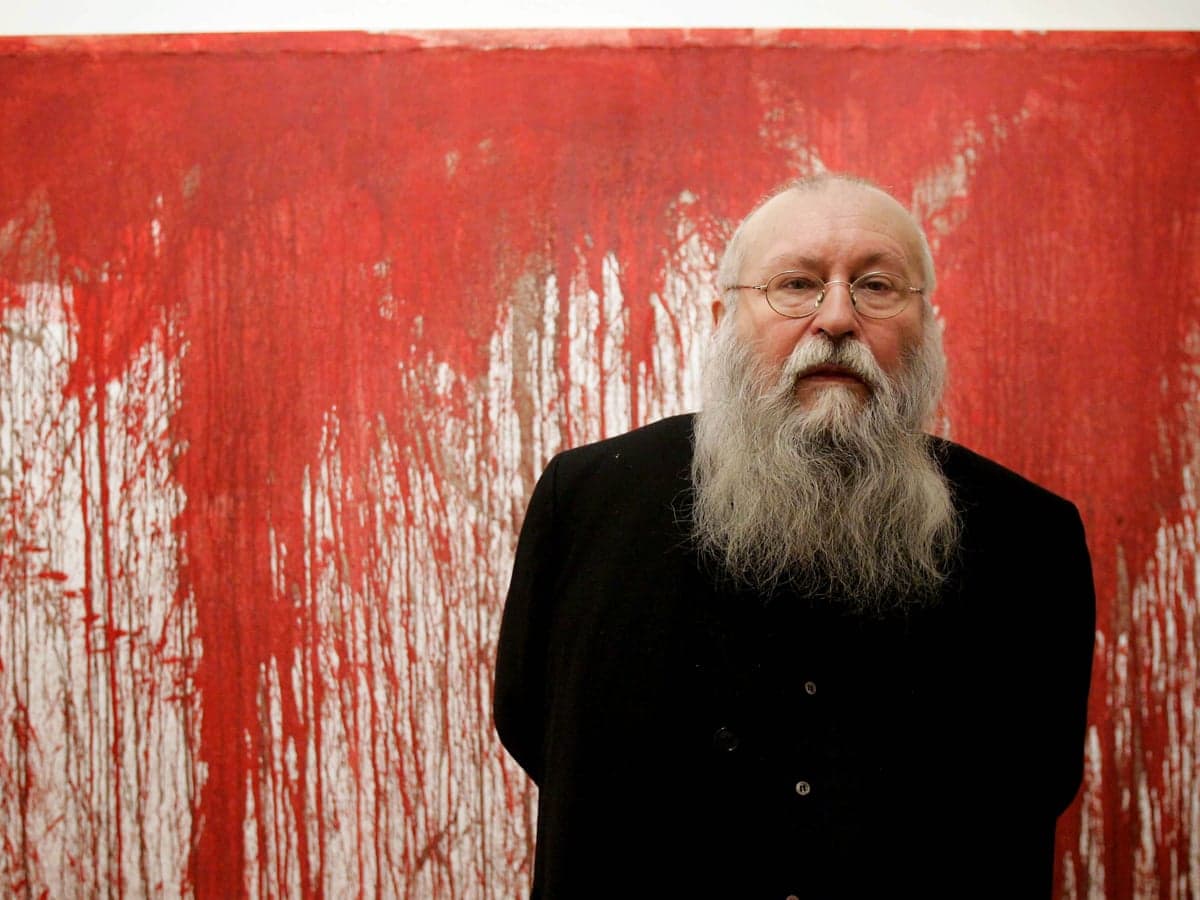
Nitsch's symbolic vocabulary was consistent and deliberate. Red, representing blood and vitality, dominated his visual language, both in performance and in the resulting "relic" paintings produced through the application of blood and paint to canvas. These paintings, often executed by pouring or splattering pigment across large-format surfaces, function as material traces of the performative act, blurring the boundary between action and object, process and product.

Notable Performances and the Sechstagespiel
Among the most significant manifestations of Nitsch's practice was the Sechstagespiel (Six-Day Play), staged at Prinzendorf Castle, the artist's residence and principal performance site in Lower Austria. This ambitious, multi-day event represented the culmination of decades of conceptual development, bringing together music, ritual action, and architectural space into an extended immersive experience. The castle itself became an essential component of Nitsch's practice, serving as both home and stage, a site where the boundaries between domestic life and artistic ritual dissolved entirely.
Nitsch's performances frequently provoked legal and institutional controversy, particularly in Austria, where his use of animal remains and explicit imagery drew criticism from religious groups, animal rights advocates, and conservative political factions. He faced prosecution on several occasions throughout his career, reflecting the broader tension between artistic freedom and public morality that characterised much of the critical reception of Viennese Actionism. Despite, or perhaps because of, this controversy, Nitsch's reputation grew steadily, and his work came to be recognised internationally as a significant contribution to the history of performance and body art.

Thematic Concerns: Catharsis, Sacrifice, and the Sacred
Across the breadth of his oeuvre, several recurring thematic concerns emerge with clarity. Foremost among these is the concept of catharsis, inherited from classical tragedy, which Nitsch positioned as the ultimate aim of his artistic project. By staging confrontations with blood, death, and bodily excess within a ritualised aesthetic context, he sought to provide audiences with a controlled encounter with the primal forces that civilisation typically suppresses.
Closely related to this is Nitsch's engagement with religious symbolism, particularly the Christian iconography of sacrifice and resurrection. His performances frequently evoked crucifixion imagery, while his use of wine and bread alongside blood gestured toward the Eucharistic ritual of communion. This syncretism of pagan and Christian symbolism situates Nitsch's work within a broader art historical tradition of artists who have sought to interrogate and reclaim religious iconography for secular or philosophical ends.
Equally significant is Nitsch's preoccupation with the body as a site of both vulnerability and transcendence. His performances consistently returned to the human form as the locus of meaning, using nudity, physical exposure, and ritualised action to foreground the body's materiality and mortality. This emphasis aligns Nitsch with broader developments in postwar body art, even as his specific theological and psychoanalytic framework distinguishes his practice from contemporaries working in a more secular idiom.

Personal Life and Later Years
Nitsch's personal life was deeply intertwined with his artistic practice. His residence at Prinzendorf Castle was not merely a private dwelling but an active extension of his creative vision, functioning as archive, studio, and performance venue simultaneously. Throughout his life, Nitsch maintained an unwavering commitment to his artistic philosophy, continuing to stage actions and produce paintings well into his later decades, even as his health and the broader cultural climate evolved around him.
He remained a controversial figure throughout his career, both celebrated within avant-garde art circles and criticised by segments of the Austrian public and press. Nevertheless, his influence on subsequent generations of performance artists is widely acknowledged, and his work has been the subject of extensive academic and curatorial attention internationally. Hermann Nitsch passed away in 2022, leaving behind an extensive body of work encompassing painting, performance documentation, musical composition, and architectural installation.

Legacy and Art Historical Significance
Hermann Nitsch's contribution to the history of performance art remains a subject of ongoing scholarly debate. For collectors and institutions engaging with his work, understanding the theoretical depth underpinning his practice is essential to appreciating its significance beyond surface-level provocation. His relic paintings, in particular, have found a place within the broader market for postwar European art, valued both for their material intensity and their conceptual lineage within the Orgien Mysterien Theatre project.
As with many artists associated with Viennese Actionism, Nitsch's legacy is inseparable from questions of ethics, representation, and the limits of artistic freedom. Yet it is precisely this unresolved tension that secures his continued relevance within art historical discourse. His insistence on confronting audiences with the unvarnished realities of the body, mortality, and ritual sacrifice positions him as a crucial figure in the broader narrative of twentieth-century art's engagement with trauma, taboo, and transcendence.
For those seeking to deepen their understanding of postwar European performance art, Nitsch's oeuvre offers a rich and challenging field of study, one that rewards careful engagement with its historical, theological, and psychoanalytic dimensions. Explore curated collections and scholarly resources dedicated to Viennese Actionism to further situate Nitsch's contribution within the broader currents of modern and contemporary art history.
Frequently Asked Questions
What is the Orgien Mysterien Theatre?
The Orgien Mysterien Theatre is Hermann Nitsch's lifelong conceptual project, a total work of art combining performance, painting, music, and ritual, drawing on Greek tragedy, Christian liturgy, and psychoanalytic theory to pursue collective catharsis.
What movement was Hermann Nitsch associated with?
Nitsch was a founding figure of Viennese Actionism, a radical Austrian art movement of the 1960s that also included Günter Brus, Otto Muehl, and Rudolf Schwarzkogler.
Why did Nitsch use blood and animal carcasses in his work?
Nitsch employed these materials as symbolic devices representing sacrifice, mortality, and purification, intending to provoke cathartic confrontation with repressed psychological and cultural taboos rather than gratuitous shock.
Where did Hermann Nitsch stage his most significant performances?
Many of his most ambitious works, including the Sechstagespiel, were staged at Prinzendorf Castle in Lower Austria, his longtime residence and principal performance site.