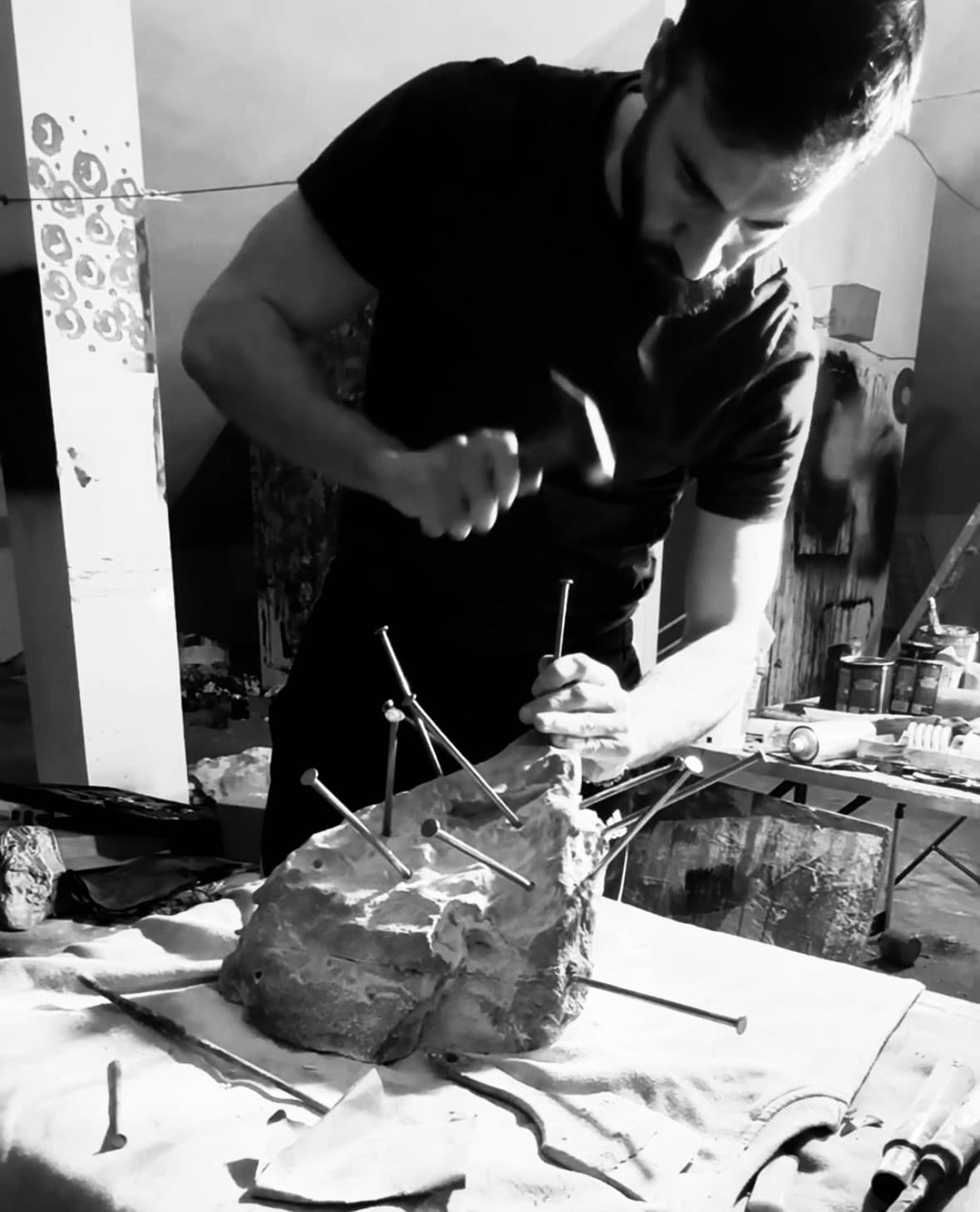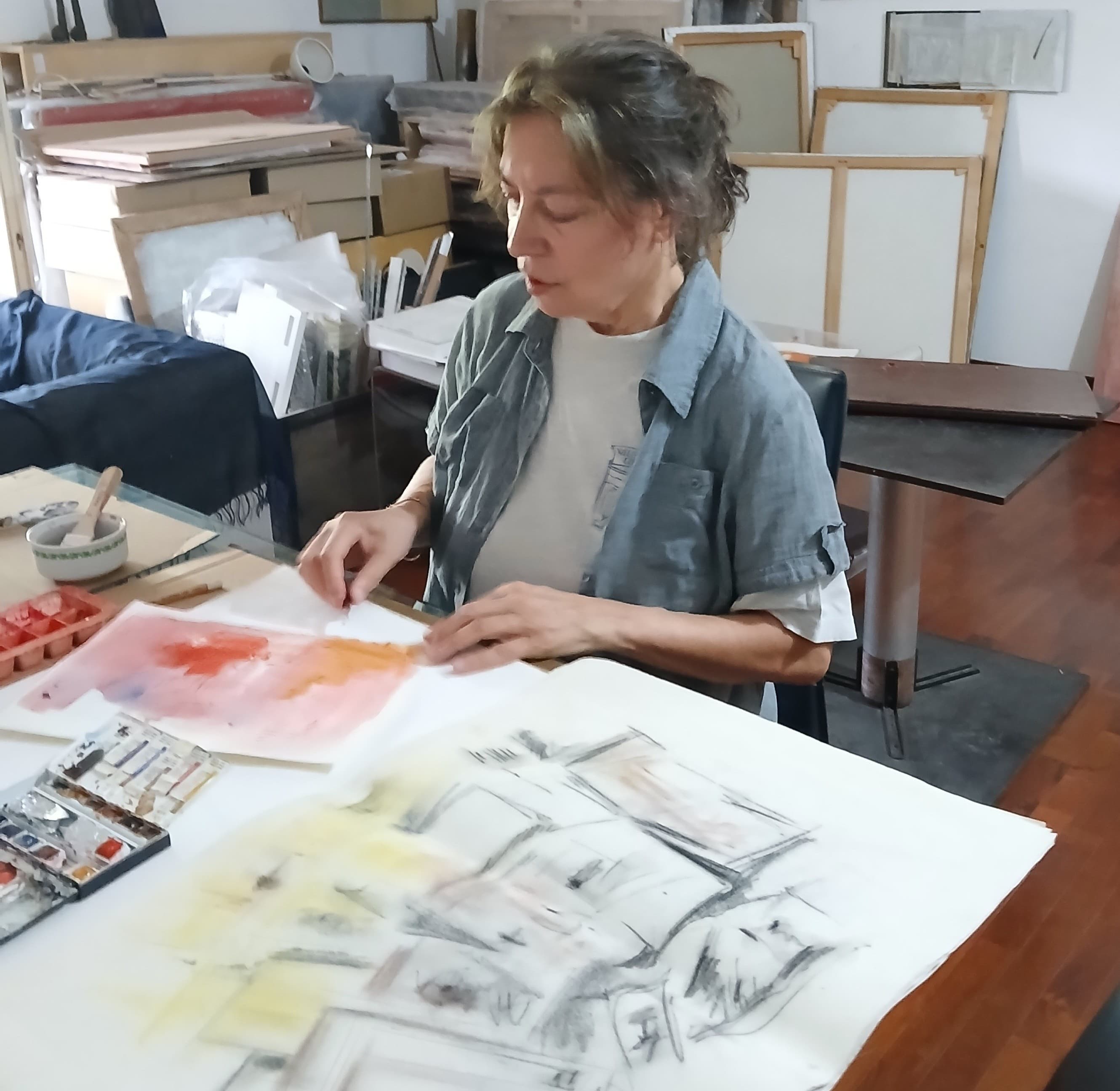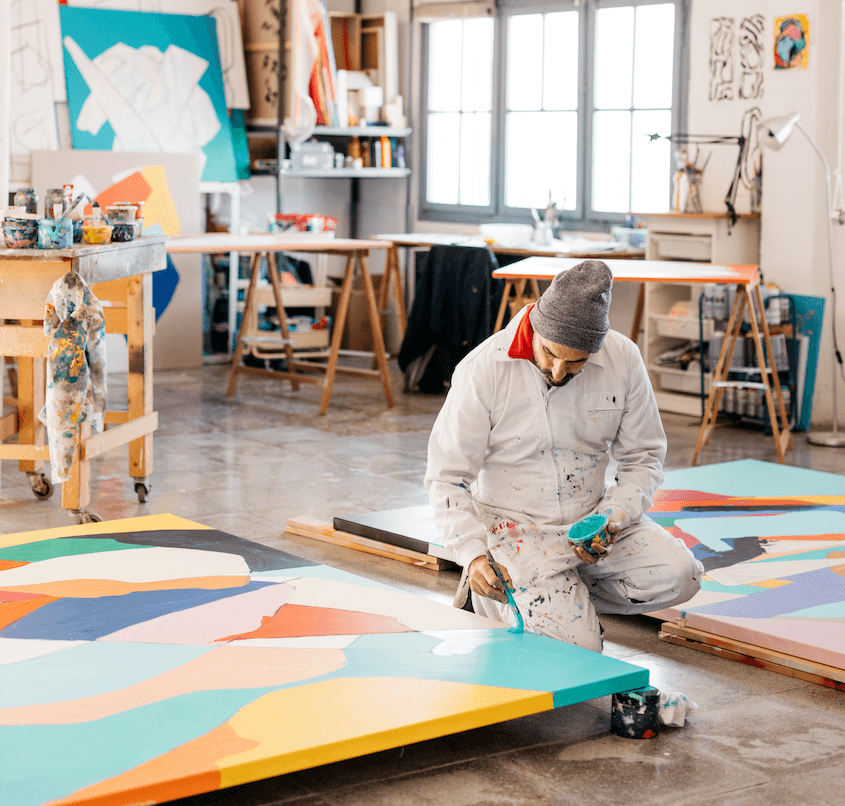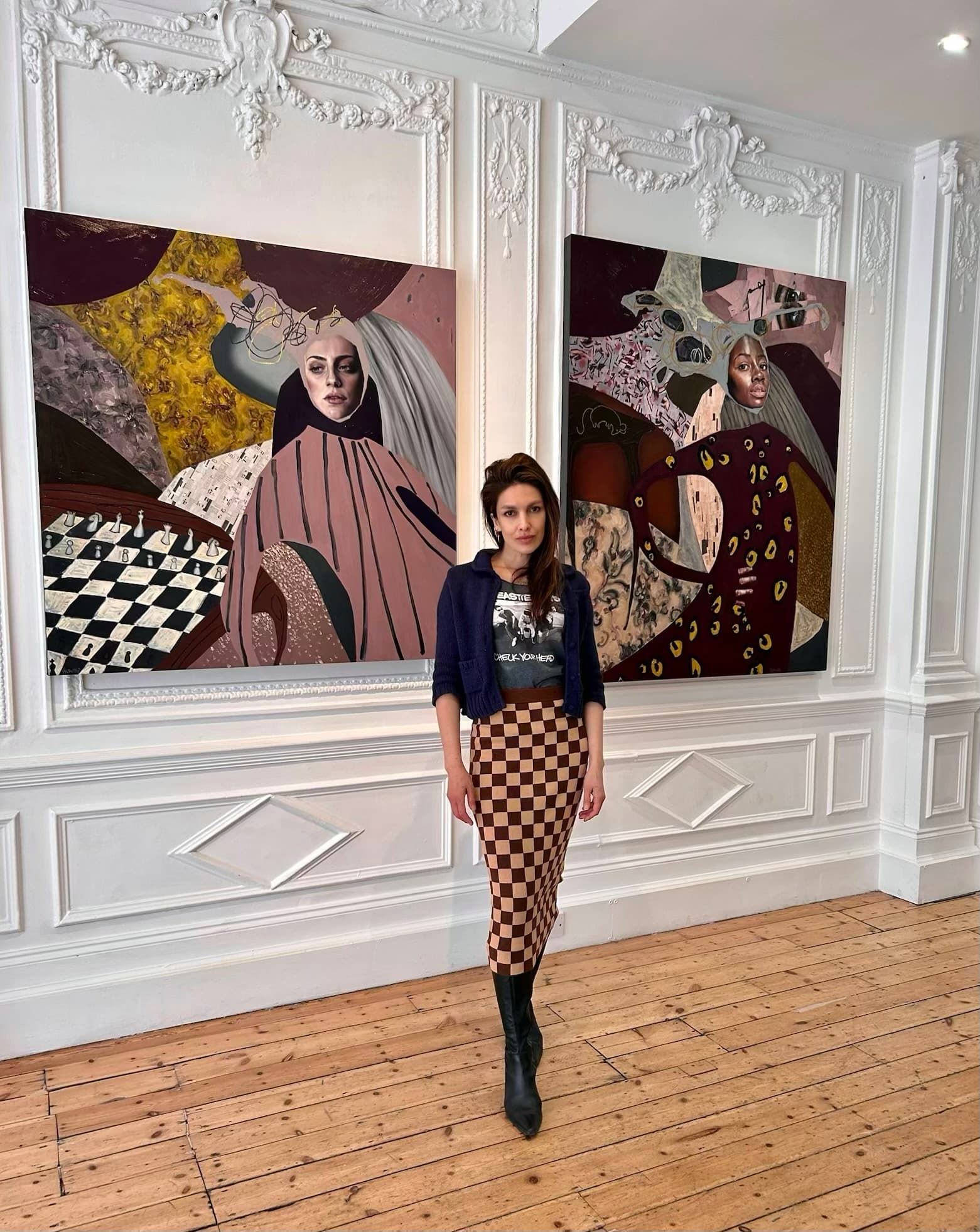
Louise Howard belongs to a generation of British painters who treat oil paint not as a means to an end, but as a subject in its own right. Born in the United Kingdom in 1982, she has built a practice around a single, sustained inquiry: the human face, rendered with technical precision and then pressed against the raw, disruptive force of abstract mark-making. Her work occupies the territory where classical figuration meets material chaos, and it does so with a confidence that has begun to attract serious attention from collectors and curators alike.
What follows is a considered look at her philosophy, her methods, and a small selection of works drawn from her ArtRewards profile. These pieces have been chosen not to catalogue her output, but to illuminate the central tensions that define it.

A Practice Built in the Studio
Howard's route into professional painting was neither sudden nor accidental. By her own account, she has always been creative; the decision to pursue art professionally was about ownership, about treating the work with the seriousness she felt it deserved. There was no epiphany, only an innate drive sustained over nearly two decades of practice.
Her formal education followed a familiar arc until it abruptly diverged. After studying art throughout her schooling, she enrolled at the Surrey Institute of Art & Design, only to leave after three months. The institution, she felt, was not engaged with what she actually wanted to do: paint. That departure proved formative. Her real training has been entirely hands-on, accumulated across thousands of hours at the canvas, learning the physical mechanics of oil paint on her own terms.
This self-directed apprenticeship matters because it explains the particular character of her surfaces. Howard did not inherit a house style. She built her technique through trial, repetition, and a willingness to sit with failure. The result is a method that feels earned rather than taught, and a relationship with her chosen medium that borders on the intimate.

Why Oil, and Why the Face
Howard works exclusively in oil. She is drawn to its weight, its slow drying time, and the depth it allows. These qualities are not incidental preferences; they are the foundation of her aesthetic. Oil's reluctance to dry permits a prolonged negotiation with the surface, a process of pushing, scraping, and rebuilding that faster media simply cannot support.
The face is her constant focus. Her stated subject is the human form, with particular attention to the face, and she is candid about seeking out features that are unusual or not conventionally beautiful. The people she paints are not professional models. They are ordinary individuals in whom she finds something worth examining.
Crucially, Howard insists there is no explicit story behind the work, and she would not want there to be. This refusal of narrative is one of the most distinctive aspects of her position, and it shapes how her paintings invite reading. They are not illustrations of events. They are objects to be confronted.

The Method Behind the Mark
For all the apparent rawness of her surfaces, Howard's process is meticulously planned. She maps out each composition on her iPad before touching a brush. The work always begins with the portrait: she identifies the precise face she wants to paint, and the rest of the picture is constructed around that focal point. Symbols and objects, whether animals, cigarettes, or domestic paraphernalia, are positioned with care. By the time she stands before the canvas, the entire piece is resolved conceptually.
What remains is execution, and this is where the drama unfolds. Howard describes sitting with the canvas through all its stages, the ugliness and the beauty, until the work feels autonomous and balanced. Her experimentation is not theoretical but visceral and technical. She tests how colours interact, weaving pure magenta, canary yellow, and cool blues into flesh tones to capture the luminous, shifting states of a body.
She also has a notable relationship with obstacles. When a canvas is not working, she does not step away. She pushes through the frustration, channelling that anger into the brush's bristles, on the conviction that resistance tends to make the work heavier and more interesting. This is a painter who treats difficulty as raw material rather than an impediment.

Realism and Disruption: The Central Tension
The defining characteristic of Howard's painting is the friction she stages between control and chaos. She pairs classical, highly technical passages, especially in faces and hands, with heavy, raw, abstract marks that disrupt the surface. This is not a stylistic flourish. It is the conceptual engine of the work.
The technical passages establish authority. They demonstrate that the disruption is a choice rather than a limitation. When an abstract gesture tears across a precisely rendered cheek, the viewer registers it as deliberate sabotage, a controlled act of violence against the painter's own facility. That tension between what is held and what is released gives the work its psychological charge.
This places Howard in direct dialogue with two figures she names. She has admired Lucian Freud since the age of fourteen, and his influence registers in her attention to flesh as substance rather than surface. Jenny Saville offers a second anchor; Howard cites the way Saville renders flesh on canvas and credits this with shaping the way she layers and handles the weight of paint. The lineage is instructive. Like Freud and Saville, Howard treats the body as terrain, and paint as a material with mass.

Painting Women, Painting Herself
Howard paints women exclusively. Her reasoning is direct: she is a woman, and it is the identity she inherently understands and relates to. She describes the work as semi-autobiographical, suggesting that she is essentially painting different versions of herself across different canvases.
Yet she resists the confessional reading. The images emerge from a private, interior world, but she does not use the canvas as a therapy couch. Personal experience is the catalyst, not the content. Once the painting begins, it becomes its own object, independent of her history. Any deeper meaning a viewer decodes is, in her words, entirely up to them.
This stance is significant within the broader landscape of contemporary figurative painting, where female-centred work is often expected to carry explicit autobiographical or political weight. Howard declines that expectation. Her women are neither symbols nor statements. They are presences, and she leaves their interpretation open.
Five Works in Focus
The following analyses draw on the limited but telling information available through Howard's ArtRewards profile: titles, dimensions, dates, medium, and pricing, read alongside her stated practice. Where visual specifics cannot be verified, the discussion remains interpretive.

Ladies what lunch
(Oil on panel, 2026, 172 x 150 cm)
At 172 by 150 centimetres, Ladies What Lunch is the largest available work on the profile. Scale alone signals ambition. Howard has spoken of wanting to heighten the psychological tension in her painting, on the principle that the larger the canvas, the more room there is for the paint to tell its own visceral story. This panel appears to be the fullest expression of that aim within the current body of work.
The title carries a faintly ironic social register. The phrase "ladies who lunch" evokes a particular class of leisured femininity, and Howard's adaptation of it suggests scrutiny rather than celebration. Read through her practice, the work likely subjects its subject or subjects to the same unsentimental attention she brings to all her faces, refusing flattery in favour of something more searching. The expanded format would allow her characteristic disruption to operate at full force, with abstract passages able to range across a wider field while the rendered features hold the composition together.

Small magics
(Oil on panel, 2026, 150 x 122 cm)
Small magics sits within Howard's standard large format. The title introduces a note of the domestic uncanny, "magics" rendered small, intimate, perhaps ordinary. Given her interest in domestic paraphernalia as compositional symbols, the work may locate enchantment within the everyday rather than the exceptional.
The 2026 date places it among her most recent output, and her stated trajectory toward larger, heavier, more uncompromising work suggests this panel would carry a dense, worked surface. The interplay between the rendered face and the surrounding field is where the painting's interest would lie: the precise focal point anchoring a surface that threatens, elsewhere, to dissolve into gesture.

All around the houses
(Oil on panel, 2026, 122 x 122 cm)
A square panel at 122 by 122 centimetres, all around the houses. The square format is worth noting; it removes the directional pull of portrait or landscape orientation and centres attention, making it well-suited to Howard's portrait-led compositions. The face can sit at the literal heart of the picture, with disruptive marks radiating outward.
The title is a colloquial phrase suggesting circuitousness, taking the long way round, and pairs naturally with Howard's use of domestic motifs. The reference to houses, however oblique, reinforces the interior, lived-in quality of her imagery. The work's recent date and balanced format make it one of the more representative examples of her current practice, a controlled meditation on a single face within a contained square field.

Fever dream
(Oil on panel, 2026, 122 x 122 cm)
Sharing the square format of All Around the Houses, Fever Dream announces its concerns in its title. A fever dream is a state of heightened, distorted perception, and the phrase aligns directly with Howard's stated interest in the luminous, changing states of a body and her practice of weaving unexpected colour, magenta, canary yellow, cool blue, into flesh.
Of the works under discussion, this title most explicitly invites a reading of altered psychological atmosphere. One might reasonably expect a surface in which the disruption tilts further toward instability, where the abstract marks feel less like commentary and more like the visual equivalent of delirium. The rendered face would then function as the still point within that turbulence, the locus of control against which the chaos registers.

Slugs and snails
(Oil on panel, 2023, 121.92 x 121.92 cm)
Slugs and snails, dated 2023 and now sold, offers a useful marker of Howard's recent development and of collector engagement with her work. Its square format anticipates the 2026 panels, suggesting continuity in her compositional thinking. The title draws on the nursery rhyme, "slugs and snails and puppy-dogs' tails," traditionally describing what little boys are made of.
For a painter who works exclusively with women and identifies her subjects as versions of herself, the appropriation of that phrase carries a quiet subversion. It gestures toward childhood, classification, and gendered expectation without resolving into a statement, consistent with Howard's refusal of fixed meaning. That the work has sold confirms that her approach is finding a market, an important professional signal for a painter operating at this price point.

Reading the Professional Signals
Beyond the canvases themselves, Howard's profile communicates a coherent professional position. Her available works are priced consistently between $10,000 and $20,000, with the larger panels commanding the higher figures. A substantial number of works are recorded as sold, including Metamorphosis, Matadora, Twins, and Slugs and Snails, indicating sustained collector interest over several years.
The most telling marker, however, is her account of staging a completely independent, self-funded solo exhibition in Mayfair. She regards taking that financial and creative risk on her own shoulders and seeing the work hold its own in that environment as her most significant accomplishment. This is more than a biographical detail. It reflects a deliberate career model.
Howard treats the business of art with the same precision as the studio, describing administration, finance, and production as different gears of the same machine. She uses Instagram heavily as a direct window into the studio, bypassing traditional gatekeepers to connect with collectors and curators. She frames commercial galleries as important partners, but insists that the artist and the gallery should meet as equal, professional collaborators. To navigate the gaps between exhibition cycles, she keeps her practice proactive, producing consistent work and creating her own platforms when necessary.

Howard's Contribution to Contemporary Painting
Several threads converge to define Howard's significance within current figurative practice. The first is her uncompromising, female-centred portraiture, sustained without recourse to the explanatory narratives so often demanded of such work. By refusing the confessional and the didactic, she returns attention to the painting as an object and to the face as a site of irreducible interest.
The second is her materially assertive oil technique. In an age of increasingly flattened, digital imagery, a condition she explicitly identifies, Howard offers something physical and complex. Her insistence on weight, depth, and the slow negotiation of the surface positions her firmly within the tradition of Freud and Saville while extending it through her particular staging of control and disruption.
The third is her artist-led career model. The self-funded Mayfair exhibition, the direct digital outreach, and the parity she demands with galleries together describe a way of working that prioritises autonomy without rejecting commercial partnership. For a market increasingly attentive to artists who own their narrative and their momentum, this is a meaningful contribution in its own right.
Finally, there is her conviction that art need not perform a public service or preach a political message to be valid. For Howard, its role is to present a raw, unfiltered human perspective. That position, held with discipline across a growing body of work, gives her painting both its integrity and its quiet force.

An Invitation to Look Further
Louise Howard's current focus is a new body of large-scale work directed toward her next solo exhibition cycle, with the stated aim of expanding scale, pushing the technical boundaries of oil paint, and remaining true to her own vision. The works examined here represent only a portion of what she has produced and continues to produce.
Readers wishing to engage more fully with her practice are encouraged to visit Louise Howard's ArtRewards profile, where her available paintings, her collected and sold works, and her wider catalogue can be explored in detail. It is the most direct way to encounter the weight, tension, and uncompromising attention that define her contribution to contemporary painting.