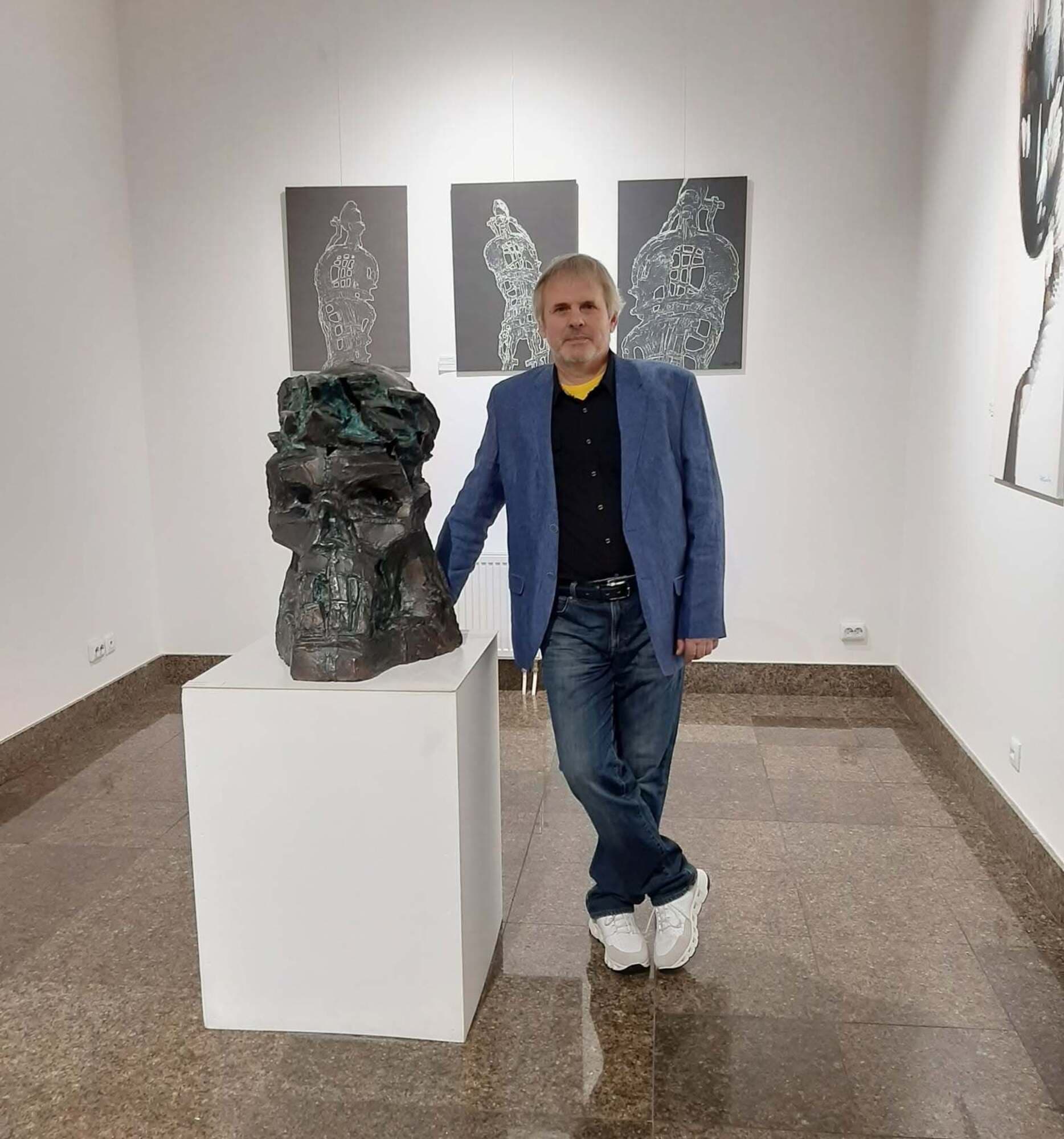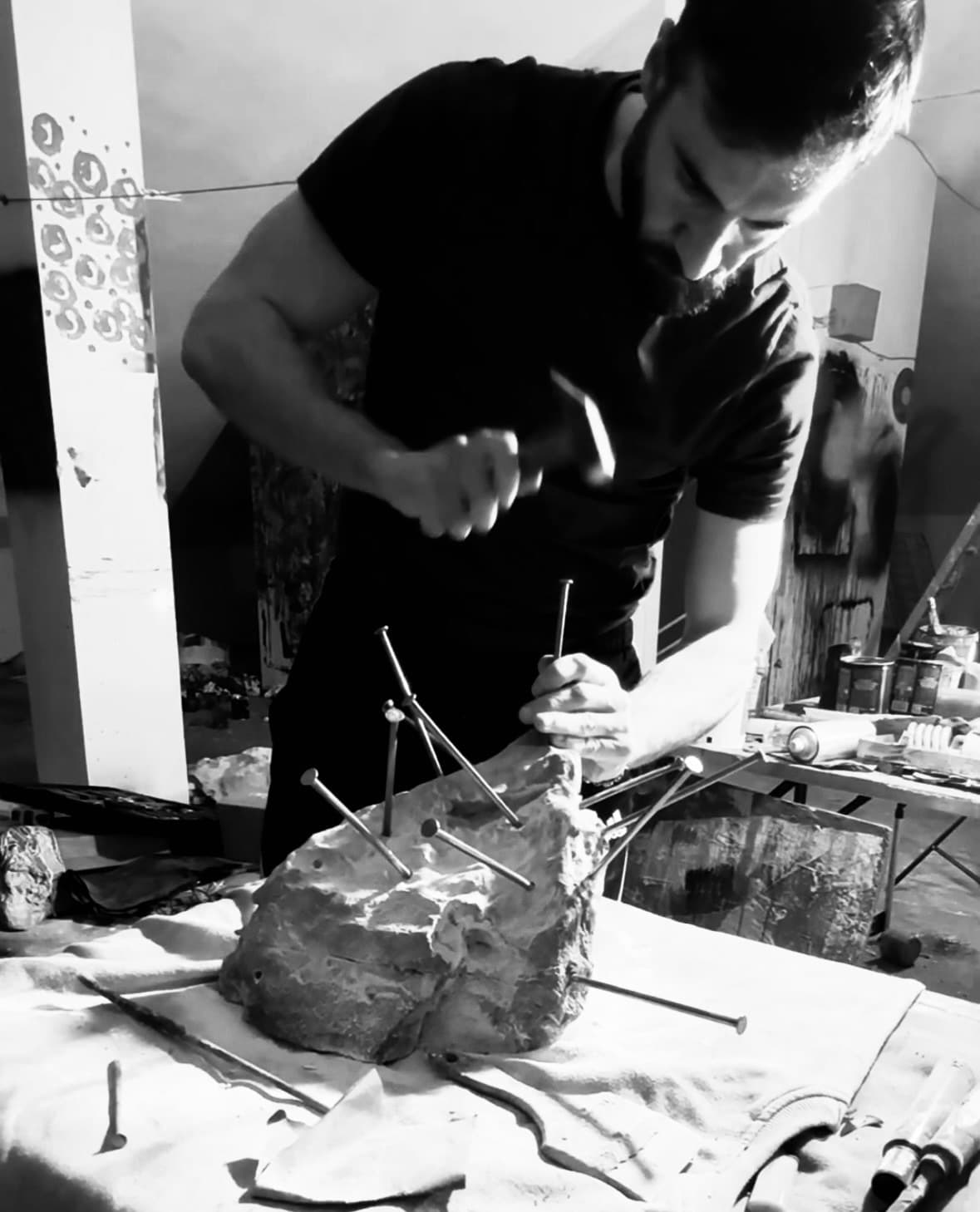
In the rugged limestone plateaus of the Murgia, where the Puglian landscape has shaped both agricultural life and collective memory for centuries, Vito Difilippo has cultivated an artistic language rooted in paradox: the transformation of the region's heaviest, most immovable material into an instrument of liberation. Born in Italy in 1988, Difilippo is a self-taught artist whose practice spans painting, sculpture, and material experimentation, with stone emerging as the defining medium of his mature body of work. His artistic trajectory, as well as the philosophical framework underpinning it, offers a compelling case study for understanding how contemporary sculptors negotiate inheritance, material, and identity.

An Artistic Philosophy Born of Place and Process
Difilippo's account of his own development resists the conventional narrative of academic formation. Lacking formal training in the visual arts, he describes his education as an "ongoing process" sustained through "direct engagement with materials" rather than institutional study. This is a significant distinction for any serious appraisal of his output: it situates him within a lineage of artists for whom technical fluency arises from sustained material dialogue rather than inherited doctrine. His background in graphic design, by his own account, contributed a disciplined sensitivity to composition and visual balance, an influence that becomes legible in the structural clarity of his sculptural forms, even where the materials themselves appear raw or unresolved.

Central to Difilippo's process is a refusal of rigid conceptual planning. He describes his work as beginning with "an image that spontaneously appears" in the mind, which he then attempts to translate into material a translation that is never a simple transcription, but a negotiation in which "the material itself guides many of the final decisions." This process-oriented methodology aligns him, by his own admission, with the legacies of Abstract Expressionism and Arte Povera: the former for its embrace of gesture and spontaneity, the latter for its elevation of humble, unrefined materials, stone chief among them, into vehicles of conceptual weight. Yet Difilippo is careful to resist strict categorisation, and this resistance itself merits critical attention. Rather than adopting a predetermined stylistic identity, he constructs an artistic vocabulary from the encounter between an initial image and the resistances of the material that houses it, allowing error and unexpected outcome to function generatively rather than as failures to be corrected.
This willingness to cede authorial control to the material recalls formalist methodologies developed within art history, particularly the attentiveness to a work's intrinsic structural and textural qualities independent of fixed narrative intention. Difilippo's sculptures invite precisely this kind of formal analysis: an examination of how surface, incision, and mass operate not merely as technical choices but as the primary bearers of meaning.

Stone as Memory: A Critical Reading of Selected Works
Among the works presented in Difilippo's ArtRewards profile, several demonstrate with particular clarity the thematic and material concerns that define his practice. The following selection has been chosen not merely for aesthetic distinction, but for the way each piece crystallises the artist's stated preoccupations with fragility, transformation, and the dialogue between human intervention and geological permanence.

Sasso Trafitto (Sculpture, 23 x 32 x 18 cm)
The title, translating roughly to "Pierced Stone", announces its conceptual proposition directly. In Difilippo's own words, stone functions in his practice as "something ancient, silent, and seemingly immutable that, through my intervention, can acquire a new identity." The act of piercing, as both a physical gesture and a symbolic rupture, positions the work as a meditation on vulnerability enacted upon a material traditionally associated with permanence and resistance. This is where an iconographic reading proves instructive: the act of puncture carries connotations that extend well beyond the purely formal, evoking wounding, penetration, and the opening of an interior previously concealed. In a sculptural tradition that has long used stone to signify endurance, from funerary monuments to architectural permanence, Difilippo's intervention destabilises that signification, proposing instead that even the most obdurate materials harbour latent fragility. The modest scale of the piece, intimate rather than monumental, reinforces this reading: the viewer is invited not to monumentalise the stone but to encounter it at the register of the body.

Sasso Ricucito (Sculpture, 17 x 22 x 32 cm)
"Mended Stone" extends the vocabulary of Sasso Trafitto into an explicitly reparative register. Where piercing announces rupture, mending implies the labour of restoration, and the implied presence of thread, suture, or binding material introduces a textile logic into the lithic register, an intersection of domestic, bodily craft with a material historically coded as monumental and masculine. This juxtaposition situates the work within a broader contemporary discourse on repair aesthetics, in which visible mending (as opposed to concealed restoration) becomes a statement of resilience rather than concealment of damage. Read through the artist's own thematic preoccupations with "fragility, strength, transformation," the work proposes that strength is not the absence of fracture but the visible, dignified management of it. Critically, this positions Difilippo's practice in productive tension with the Arte Povera tradition from which he draws partial inspiration: where that movement often foregrounded the unprocessed, "poor" materiality of its objects, Difilippo introduces a labour-intensive, almost devotional act of care that complicates any straightforward reading of rawness.

Lacrime di Pietra (Sculpture, 25 x 30 x 25 cm)
"Tears of Stone" operates through a deliberate oxymoron: stone, by definition, cannot weep. The title's impossibility is precisely its conceptual engine, forcing a confrontation between the material's actual properties and the emotional projection the artist asks it to bear. This tension exemplifies what Difilippo describes as his interest in "the way certain artists can transform material into something capable of conveying presence or emotion." The work can be productively situated within a critical framework attentive to the concept of aura, the unique, non-reproducible presence an object holds in time and space. By anthropomorphising an inert material, Difilippo does not simply decorate stone with sentiment; he stages an encounter in which the viewer is asked to locate emotional resonance in an object culturally coded as impassive. The relatively compact, near-cubic dimensions of the piece lend it a quality of concentrated density, as though grief itself has been compressed into geological form.

Gabbia del Male (Mixed Media, 30 x 30 x 18 cm)
Departing from pure stone into mixed media, "Cage of Evil" signals a shift toward a more explicitly structural and architectural vocabulary, the cage as a device of containment, restriction, and exposure simultaneously. This piece warrants particular critical attention for the way it operationalises containment as both protective and punitive. Enclosure, in the history of sculptural form, has carried dual connotations: the reliquary that protects a sacred object, and the prison that restrains a dangerous one. Difilippo's titling suggests the latter register is foregrounded, yet the use of mixed media rather than stone alone indicates a widening of his material vocabulary beyond the lithic, supporting his own account of a practice "in which painting, sculpture, and material experimentation coexist." Approached through a lens attentive to the social and material conditions of artmaking, the cage motif might also be read as a commentary on constraint more broadly professional, psychological, or cultural resonating with the artist's reflections on the tension between creative freedom and the structural demands of a "competitive and fast-paced system."

Colonizzato 004 (Sculpture, 18 x 28 x 20 cm)
The Colonizzato series, of which this work is a numbered iteration, suggests a sustained serial investigation that engages directly with the vocabulary of colonisation, occupation, and territorial imposition. This title diverges from the more intimate, bodily register of the stone works discussed above, gesturing instead toward a historical and political register. Serial production within a sculptural practice often indicates a sustained formal or conceptual problem the artist returns to repeatedly, testing variation within a stable conceptual frame a methodology consistent with Difilippo's described interest in experimentation as a generative, rather than conclusive, process. Read against the artist's own account of the Murgia landscape as "a constant presence" that enters his work "not simply as representations, but as experiences," the Colonizzato series might be understood as an oblique engagement with the historical forces agricultural, industrial, touristic that have shaped and reshaped his native terrain. The relatively compact scale across the series suggests an interest in the object as totem or fragment rather than monument: a shard of a larger historical condition rendered legible through the lens of an individual sculptural gesture.

Professional Trajectory and Critical Reception
Difilippo's account of his professional development reveals a considered, deliberately paced approach to career-building, one that privileges consistency of artistic language over rapid market visibility. He has presented his work across European and Asian contexts, an international exposure that has allowed his sculptural vocabulary rooted so specifically in the Puglian landscape to enter dialogue with markedly different cultural and critical frameworks. This cross-cultural circulation is significant: works so deeply inflected by a particular geography risk either losing specificity in translation or, conversely, gaining resonance precisely because their regional particularity reads as authentic testimony in an increasingly homogenised global art market.
Notably, Difilippo maintains a clear separation between the demands of artistic research and the commercial apparatus surrounding presentation and promotion, stating that he does not allow external feedback to "determine the direction" of his work, even as he remains open to the perspectives such feedback offers. This stance, attentive but not subordinate to market and critical reception, speaks to a maturity of practice increasingly rare amid pressures for artists to continuously adapt their output to platform-driven visibility. His emphasis on documenting process alongside finished pieces further reflects an understanding, shared by many successful contemporary practitioners, that transparency around method can deepen rather than dilute critical and collector engagement.

Conclusion: A Practice of Sustained Transformation
What emerges from this examination of Vito Difilippo's statements and selected works is a practice unified less by a single stylistic signature than by a consistent philosophical commitment: the conviction that transformation of material, of landscape, of inherited limitation constitutes the fundamental work of sculpture. Stone, in his hands, ceases to function as a symbol of permanence and becomes instead a surface upon which fragility, memory, and repair can be enacted and made visible. As his practice continues to evolve toward what he describes as an increasingly ambitious engagement with "sculpture, material, and space," collectors and critics alike have reason to follow the development of a vocabulary still very much in formation, yet already distinguished by its conceptual rigour and material sensitivity.
Those wishing to engage further with this evolving body of work are invited to explore Vito Difilippo's complete portfolio on ArtRewards, where the full range of his sculptural investigations, from the intimate Sasso series to the historically inflected Colonizzato works, can be viewed and considered in greater depth.